
AIA Pittsburgh
  • About
    • About AIA Pittsburgh
      • Mission, Vision & Values
        • Equity, Diversity, and Inclusion Statement
      • Board Leadership
      • Staff Members
      • AIA PA Chapter Map
      • Annual Reports
    • AIA Committees
      • Advocacy Committee
      • AIA-MBA Joint Committee
      • Allied Members Group
      • Committee on the Environment (COTE)
      • Design + Research Group
      • EDI Community
      • Education Committee
      • Fellows Group (FAIA)
      • Healthcare Committee
      • Outreach Committee
      • Young Architect Forum (YAF)
    • Rent Our Space
    • Sponsorships
    • Contact
  • Membership
    • Why Join
    • Membership Types
    • Allied Membership
    • Directories
      • Firm Directory: Find an architect to work with
      • For Members: National AIA Member Finder
      • Allied Members Directory
  • Events
    • Calendar
    • Build Pittsburgh
      • Presenters & Programming
      • Sponsor & Exhibitor Opportunities
    • Design Pittsburgh
      • Young Architects Studio Competition
      • Award Archives
    • Architecture Week
    • PechaKucha Night Pittsburgh
    • Procrastinator’s Day
  • Resources
    • Job Board
      • Post a Job
      • Manage your job listings
    • Classifieds
    • Professional Resources
    • Order AIA Contract Documents
    • For the Public
      • Find an Architect or Firm
      • FAQs: Working With an Architect
      • Architecture Learning Network
  • Columns
    • 2025 COLUMNS Newsletters
    • COLUMNS Blog Features: 2012-Present
      • Member Dossiers
      • Committee Corner
      • From The Firms
      • News
    • COLUMNS: 1987-2011
  • Foundation
    • About the Foundation
    • Board of Directors
    • The Leadership Institute
    • Donate
  • Job Board
  • Member Login
AIA Pittsburgh
  • Job Board
  • Member Login
  • About
    • About AIA Pittsburgh
      • Mission, Vision & Values
        • Equity, Diversity, and Inclusion Statement
      • Board Leadership
      • Staff Members
      • AIA PA Chapter Map
      • Annual Reports
    • AIA Committees
      • Advocacy Committee
      • AIA-MBA Joint Committee
      • Allied Members Group
      • Committee on the Environment (COTE)
      • Design + Research Group
      • EDI Community
      • Education Committee
      • Fellows Group (FAIA)
      • Healthcare Committee
      • Outreach Committee
      • Young Architect Forum (YAF)
    • Rent Our Space
    • Sponsorships
    • Contact
  • Membership
    • Why Join
    • Membership Types
    • Allied Membership
    • Directories
      • Firm Directory: Find an architect to work with
      • For Members: National AIA Member Finder
      • Allied Members Directory
  • Events
    • Calendar
    • Build Pittsburgh
      • Presenters & Programming
      • Sponsor & Exhibitor Opportunities
    • Design Pittsburgh
      • Young Architects Studio Competition
      • Award Archives
    • Architecture Week
    • PechaKucha Night Pittsburgh
    • Procrastinator’s Day
  • Resources
    • Job Board
      • Post a Job
      • Manage your job listings
    • Classifieds
    • Professional Resources
    • Order AIA Contract Documents
    • For the Public
      • Find an Architect or Firm
      • FAQs: Working With an Architect
      • Architecture Learning Network
  • Columns
    • 2025 COLUMNS Newsletters
    • COLUMNS Blog Features: 2012-Present
      • Member Dossiers
      • Committee Corner
      • From The Firms
      • News
    • COLUMNS: 1987-2011
  • Foundation
    • About the Foundation
    • Board of Directors
    • The Leadership Institute
    • Donate
COLUMNS - A news source and blog for the architectural community.

Simply Stated

June 4, 2014

Post Category | News

w-SimplicityCover

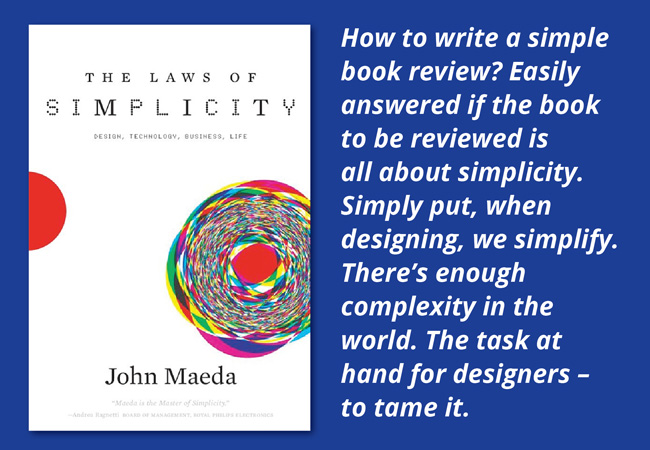
John Maeda is a master of simplicity, a professor in MIT’s Media Lab, and an accomplished graphic designer. His work explores the question of how we can redefine the notion of “improved”. It doesn’t mean that bigger is better but rather that less is (indeed) more. He sees simplicity as equal to our sanity, stating “technology has made our lives more full, yet at the same time we’ve become uncomfortably full.”

My own design process is defined by not overthinking a problem and generally offering a simple, “un-designed” solution. This doesn’t mean no design, but simply less. This seems important if we’re constructing 100-year buildings. To stand the test of time, these structures “must first be beautiful”(1) and offer flexible spaces for future unforeseen uses. An un-designed process seeks common ground, not specific spaces. This is also the first and most necessary of Maeda’s ‘laws’ within his Laws of Simplicity – REDUCE.

This short but sweet little book breaks down his ten laws into three successive sets corresponding to increasingly complicated conditions of simplicity: basic, intermediate, and deep. For this simple review, I won’t list all ten of the author’s laws, just the top three that have informed my work, one from each of the his three sets.

LAW 1 / REDUCE: The simplest way to achieve simplicity is through thoughtful reduction. There’s a reason this is the first and most important law, especially when it comes to conservation. It is only with reduced consumption that our buildings will be more responsible, as we reduce their dependency upon fossil fuels. In our buildings, we can reduce the energy they use by simply placing them in connected communities, easily accessible to everyone.

LAW 6 / CONTEXT: What lies in the periphery of simplicity is definitely not peripheral. At Build Pittsburgh 2010, keynote speaker Bill Black advised the audience that “it’s better for a modern designer to be wider in breadth of knowledge than deep into a specialty area of practice”(2). For architecture, along with context comes responsibility(3)… flexible and fun – yes, slave to fashion – no! Perhaps the case for a “minimalist” style is made in the book, as Maeda suggests that “creating white space or, ‘clean space’ enables the foreground to standout from the background.” So white space is not the absence of context, but perhaps the best way to simplify it?

LAW 7 / EMOTION: More emotions are better than less. Simplicity can  be considered ugly, so this law may not be for everyone. It also “seems to contradict the first Law of REDUCE” as a way to literally stay in touch with “just the right kind of feel, and feel for”. So this now evolves my personal law of “form follows formula”(4). For Maeda, “Form follows function gives way to the more emotion-led approach to design: Feeling follows form”.

So, simplicity is… sensitive, sensible, and necessary for our sanity. The author deems the book to be a starting point and it is complimented by his blog www.lawsofsimplicity.com. It, too, is an ever-evolving search for simplicity and meaning. He’s now also moved into the essential exploration of the meaning of design at www.whatisdesign.net and the business of design at  www.designandventure.org.

Share:
  • Facebook
  • Twitter
  • LinkedIn

Categories

  • All Posts
  • Committee Corner
  • From The Firms
  • Member Dossiers
  • News
  • Archived Newsletters

Search Columns

Archives

Get the latest in your inbox.

AIA Pittsburgh

925 Liberty Avenue
Suite 700

Pittsburgh, PA 15222 USA

Phone: 412-471-9548

Contact Us
Quick Links
  • Job Board
  • Sponsorships
  • Donate
  • AIA.org
Follow us
  • Facebook
  • Twitter
  • LinkedIn
  • Instagram

Copyright © 2025 AIA Pittsburgh. All rights reserved. Site by Imagebox.